When Test Results Arrived by Mail and Worry Lasted for Weeks: How Medical Anxiety Used to Be a Marathon, Not a Sprint
When Test Results Arrived by Mail and Worry Lasted for Weeks: How Medical Anxiety Used to Be a Marathon, Not a Sprint
Picture this: You leave your doctor's office after a routine blood test, and the receptionist cheerfully tells you, "We'll call you in about ten days with the results." Ten days. Not ten minutes, not even ten hours. For most of American medical history, this wasn't unusual — it was simply how healthcare worked.
Today, we live in an era where pregnancy tests give results in three minutes, blood sugar readings appear instantly on our phones, and even complex lab work often comes back within 24 hours. But this lightning-fast medical feedback loop is a remarkably recent development that has fundamentally altered not just the mechanics of healthcare, but the entire emotional landscape of being a patient.
The Era of Medical Patience
In the 1970s and 1980s, getting medical results was an exercise in forced patience that would seem almost cruel by today's standards. Blood work disappeared into laboratory black holes for a week or more. X-rays were developed like photographs in darkrooms, often requiring overnight processing. Pregnancy tests meant a trip to the doctor's office and a wait that could stretch for days.
Dr. Margaret Chen, who practiced internal medicine in Chicago throughout the 1980s, remembers the rhythm well: "We'd draw blood on Monday, and if we were lucky, we'd have results by Friday. Patients would call constantly asking if anything had come in. The anxiety was just part of the process."
This wasn't medical incompetence — it was simply the reality of analog healthcare. Lab technicians processed samples in batches. X-ray films needed time to develop properly. Pathology reports were typed on actual typewriters and mailed through the postal system. The infrastructure of instant results simply didn't exist.
The Waiting Game's Hidden Costs
That extended waiting period created a unique form of medical limbo that shaped how Americans experienced illness. Unlike today's quick resolution of uncertainty, patients in previous decades lived in prolonged states of "not knowing" that could stretch for weeks.
Consider a routine mammogram in 1985. After the uncomfortable procedure, women would return home and wait. And wait. The film needed to be developed, reviewed by a radiologist, and the report typed and mailed. Two weeks later, a letter would arrive — hopefully with good news, but sometimes requesting additional testing or a callback.
"Those two weeks were brutal," recalls Linda Martinez, now 67, describing her mammography experiences in the 1980s. "You'd go about your daily life, but there was always this cloud hanging over you. Every time the phone rang or the mail came, your heart would skip."
This extended uncertainty created coping mechanisms that have largely disappeared. Families developed elaborate rituals around "waiting for results." Some people threw themselves into work or hobbies as distraction. Others became consumed by worst-case scenarios, spending weeks researching potential diagnoses in medical encyclopedias at the library.
The Trust Factor
Interestingly, the slow pace of results also created a different relationship between patients and doctors. With no ability to Google symptoms or cross-reference lab values online, patients had little choice but to trust their physicians completely. The doctor was the sole interpreter of mysterious medical data.
"Patients were much more willing to wait because they had to be," explains Dr. Robert Kim, a family physician who has practiced for over 40 years. "There was less questioning, less second-guessing. When I said 'we'll have your results next week,' that was just accepted as how medicine worked."
This enforced patience also meant that minor health concerns often resolved themselves before results arrived. A suspicious mole that cleared up, a concerning pain that disappeared, or fatigue that lifted — by the time test results confirmed everything was normal, patients had often forgotten why they were worried in the first place.
The Digital Revolution Changes Everything
The transformation began gradually in the 1990s but accelerated dramatically in the 2000s. Digital imaging eliminated film development time. Automated laboratory equipment could process hundreds of samples per hour. Electronic medical records allowed instant transmission of results from lab to doctor to patient.
By 2010, many hospitals offered online patient portals where results appeared automatically, often before the doctor had even reviewed them. Home testing kits proliferated, putting everything from cholesterol levels to genetic predispositions at our fingertips.
The COVID-19 pandemic supercharged this trend. Rapid antigen tests delivered results in 15 minutes. At-home PCR kits promised results within 24 hours. The idea of waiting a week for basic health information suddenly seemed not just inconvenient, but almost medically irresponsible.
The New Anxiety of Instant Everything
But faster hasn't necessarily meant better for our collective mental health. The immediate availability of medical information has created new forms of anxiety. Patients now receive lab results at 11 PM on a Friday, with no doctor available to explain what slightly elevated numbers might mean. Online portals deliver potentially concerning findings with no context or reassurance.
"I see more anxiety now, not less," observes Dr. Kim. "Patients get their results instantly, Google everything, and arrive at their follow-up appointment convinced they're dying. The waiting used to be hard, but at least it came with built-in medical guidance."
The shift has also changed our tolerance for uncertainty. Where previous generations accepted medical waiting as natural, today's patients expect immediate answers to complex health questions. A test result that takes three days feels unreasonably slow; a week feels negligent.
Living in Medical Real-Time
Today's medical landscape operates in something approaching real-time. Continuous glucose monitors send blood sugar readings to smartphones every minute. Smartwatches track heart rhythms and alert users to irregularities instantly. Some pregnancy tests can detect hormones days before a missed period.
This acceleration has undoubtedly saved lives through earlier detection and faster treatment. But it has also fundamentally altered the emotional experience of healthcare, replacing the forced patience of previous eras with the immediate anxiety of constant monitoring.
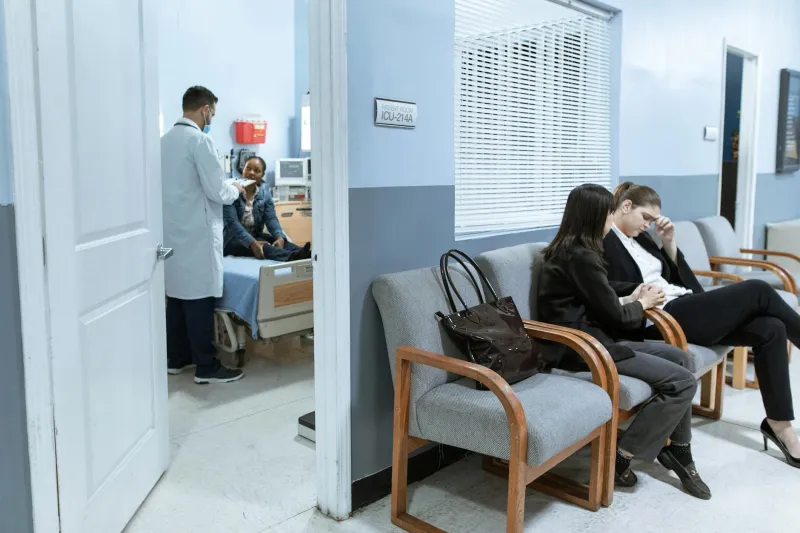
The waiting room used to be both a physical place and a mental state — a space where uncertainty was simply part of the healing process. Today, we carry that waiting room in our pockets, but the waiting itself has largely disappeared, replaced by the different but equally complex challenge of processing medical information in real-time.
In gaining the ability to know everything immediately, we've lost something harder to quantify: the peculiar peace that sometimes came with having no choice but to wait, hope, and trust that time would reveal what we needed to know.