The Barber Who Knew Everything: When a $2 Haircut Was Actually About Something Else Entirely
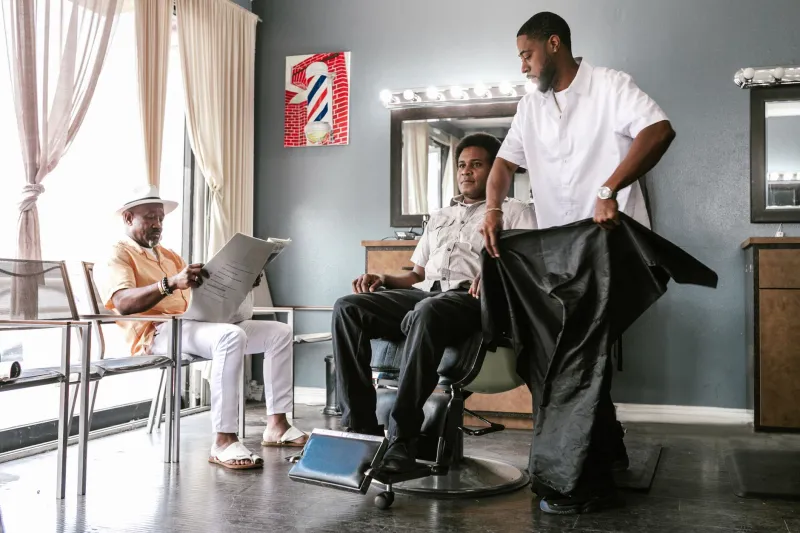
Walk into a classic American barbershop in 1965 and you'd encounter a specific atmosphere that no interior designer has ever successfully recreated. The smell of talcum powder and Pinaud Clubman. The low murmur of a baseball game on a transistor radio. Three or four men in various stages of waiting, not staring at phones because phones didn't exist yet as waiting-room companions, but actually talking to each other. And behind the chair, a man who had probably been cutting hair in that same spot for twenty years and knew more about the neighborhood than the local newspaper.
The barber wasn't just a craftsman. He was an institution.
The Shop That Never Closed Its Ears
For most of the 20th century, the American barbershop occupied a unique social position. It was one of the few places where men could gather without a specific purpose — no game to watch, no deal to close, no agenda beyond the vague requirement of a haircut every few weeks. That purposelessness was precisely what made it valuable.
Men who might never sit down and have a direct emotional conversation found themselves talking in barbershops. About work troubles, about marriages that were straining, about kids who were worrying them, about money that wasn't stretching far enough. The barber, positioned behind and slightly above, became a kind of accidental confessor. The intimacy of having someone's hands near your head, the ritual nature of the chair, the fact that you couldn't really leave mid-conversation — all of it created a space where things got said that didn't get said anywhere else.
Barbers absorbed an enormous amount of community knowledge. They knew who was hiring and who was struggling. They heard about illnesses before the news spread. They understood the social dynamics of their neighborhood in ways that outsiders simply couldn't access. In Black communities especially, the barbershop served as a critical gathering place — a space of cultural exchange, political conversation, and mutual support that operated largely outside white institutional structures. That tradition remains vibrantly alive in many communities today, even as the broader institution has transformed.
What a Haircut Actually Cost
The economics were deliberately accessible. Through much of the mid-20th century, a men's haircut cost between $1 and $3 in most American towns — expensive enough to be a real service, cheap enough that skipping it wasn't really an option. The price reflected a transaction that was, fundamentally, about maintenance rather than luxury.
You didn't go to the barber to treat yourself. You went because your hair had gotten long. The experience was pleasant, even enjoyable, but it wasn't positioned as self-care or a premium service. It was just something men did, regularly, affordably, and without much deliberation.
This accessibility meant that the clientele was genuinely mixed. The factory worker and the bank manager sat in the same waiting chairs, read the same dog-eared magazines, and listened to the same barber's opinions about the local football team. The barbershop was one of the few commercial spaces in American life that wasn't particularly stratified by class. Everyone's hair grew at roughly the same rate.
The Transformation Begins
The shift started gradually in the 1970s and accelerated through the 1980s and 1990s. Unisex salons emerged, pulling some male customers toward a different kind of experience. Chain operations — Supercuts, Great Clips — entered the market promising speed and consistency at low prices, which effectively split the market. You could get a fast, cheap, anonymous haircut at a strip mall, or you could pay more for something that felt like a destination.
The middle ground — the neighborhood shop, the barber who knew your name, the unhurried social experience — began to erode. Rents rose. The old barbers retired and weren't always replaced. The cultural glue that had held the institution together weakened as neighborhoods changed, as men's routines changed, as the whole architecture of community life shifted.
Then, in the 2010s, something unexpected happened. The barbershop came back — but transformed almost beyond recognition.
The $65 Fade and the Warm Towel Experience
Today's high-end grooming establishments bear the aesthetic markers of the classic barbershop — the striped pole, the vintage chairs, the straight-razor shave — while operating on an entirely different economic and cultural logic. Appointments are booked online, sometimes weeks in advance. Services include beard sculpting, hot towel treatments, and grooming product consultations. The price for a standard men's haircut in many American cities now runs between $40 and $80, with premium shops charging considerably more.
This isn't inherently bad. The craft of barbering has genuinely elevated. The technical skill available at a good modern shop often exceeds what was typical in the old neighborhood places. The experience is comfortable, attentive, and professionally executed. Men who care about their appearance have access to genuinely excellent grooming services in a way that simply wasn't available before.
But something changed in what the transaction means. Today's barbershop visit is often a deliberate act of self-investment — scheduled, budgeted for, positioned as a treat. The barber is a skilled service provider rather than a neighborhood fixture. The conversation, when it happens, is pleasant but not rooted in shared community knowledge. You're a client, not a regular, even if you come every three weeks.
What the Chair Used to Hold
The old barbershop filled a gap in American men's social lives that we're only now beginning to understand was a gap at all. Research on male loneliness and social isolation has expanded significantly in recent years, and what it describes — men who lack close friendships, who have few spaces for genuine conversation, who are socially isolated in ways that damage their health — is partly a story about the disappearance of the informal gathering places that once structured male community life.
The barbershop was one of those places. So was the bowling alley, the corner tavern, the neighborhood hardware store where you could spend an hour pretending to look for a specific bolt. These weren't luxury experiences. They were the connective tissue of everyday social life, and their erosion left something missing.
The premium grooming experience is a fine thing. But it isn't a replacement for the barber who knew your father, remembered your kids' names, and had an opinion about everything happening within six blocks. That guy was providing something that didn't show up on the receipt.