Where Men Solved Life's Problems One Snip at a Time: How America's Barbershop Lost Its Soul
The Chair That Heard Everything
Walk into any barbershop before 1990, and you'd find something that's nearly extinct today: men actually talking to each other. Not about sports stats they'd googled that morning or work emails they needed to answer, but real conversation. The kind that meandered from local politics to marriage troubles to whether the new highway would kill downtown business.
The barbershop wasn't just where you got your hair cut. It was where you got your bearings.
When Fifteen Bucks Bought You More Than a Trim
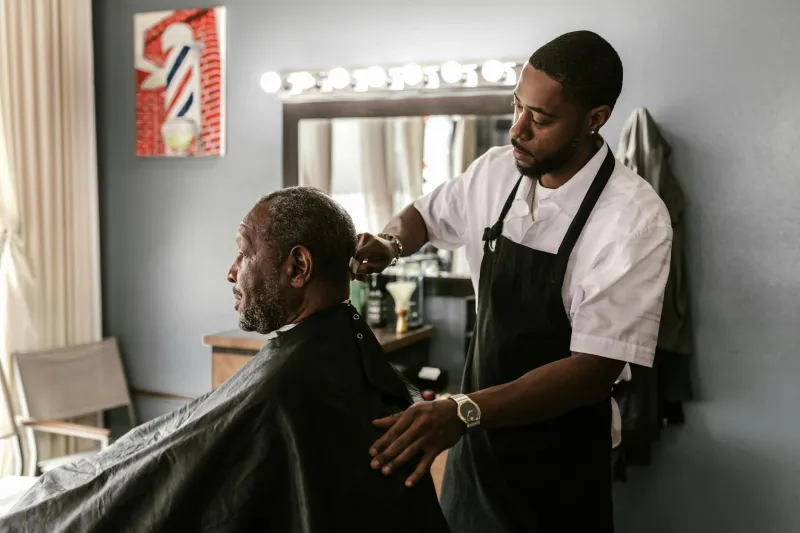
Back then, a haircut cost about what you'd spend on lunch. But the real value wasn't in the service—it was in the ritual. You'd settle into that worn leather chair, and for the next forty minutes, you were part of something bigger than yourself. The barber knew your name, your kids' names, probably your dad's name too. He'd been cutting hair in the same spot for twenty years, and the conversations that happened in his shop were the unofficial town hall meetings.
Regular customers had their own unspoken schedule. Tuesday afternoons belonged to the retirees who'd hash out everything from Social Security to grandchildren. Saturday mornings drew the working men who'd decompress from their week while their kids got buzz cuts in the smaller chair. The barber wasn't just wielding scissors—he was conducting a symphony of community connection.
The Therapist Who Never Charged Extra
Here's what made those old barbershops special: they were one of the few places where men were allowed to be vulnerable. Wrapped in that cape, staring at yourself in the mirror, something about the setting made it okay to admit when life was getting heavy. The barber had heard it all before—job losses, divorce papers, sick parents, kids going off the rails.
And somehow, between the steady snip of scissors and the familiar rhythm of conversation, problems seemed more manageable. Not because the barber had all the answers, but because he'd listen without judgment and offer the kind of practical wisdom that came from cutting hair and hearing stories for decades.
"My barber knew more about what was happening in my life than my own brother," remembers Tom Martinez, 67, from Phoenix. "When my dad died, I didn't go to a grief counselor. I went to Sal's shop, sat in that chair, and talked it through while he worked on my hair. Cost me twelve bucks and probably saved my sanity."
 Photo: Tom Martinez, via images-wixmp-ed30a86b8c4ca887773594c2.wixmp.com
When Getting a Haircut Required Human Interaction
Contrast that with today's salon experience, and you'll understand what we've lost. You book online, show up at your appointed time, and slide your card through a tablet that prompts you to tip before you've even seen the results. The stylist is perfectly professional, but they're juggling six clients, checking their phone between cuts, and following whatever trend they learned on Instagram last week.
The conversation, if there is any, feels forced. They'll ask about your weekend plans while mentally calculating how quickly they can move you along. There's no time for life advice when you're booked solid every fifteen minutes.
The Death of the Third Place
Sociologist Ray Oldenburg coined the term "third place" to describe those spaces that aren't home or work—the informal gathering spots where community happens naturally. Barbershops were the ultimate third place for men, filling a role that nothing has quite replaced.
 Photo: Ray Oldenburg, via www.tazzami.it
Sure, there are gyms and sports bars, but try having a meaningful conversation over blasting music and ESPN highlights. Coffee shops are too transient, everyone hunched over laptops. Even churches struggle to create the kind of regular, informal interaction that happened when you'd run into the same guys at the barbershop every few weeks.
What Sixty Dollars Doesn't Buy
Today's salon experience is undeniably more polished. The chairs are more comfortable, the products are better, and your stylist probably has more formal training than the old-school barbers who learned their trade through apprenticeship. But all that professionalism comes with a distance that the corner barbershop never had.
You're paying three times as much for a service that's technically superior but emotionally hollow. The stylist doesn't know your story because they don't have time to learn it. The other customers aren't neighbors—they're strangers scrolling through their phones while they wait.
The Unspoken Rules That Built Community
The old barbershop had its own social code that everyone understood. You didn't interrupt when someone was sharing something serious. You kept what you heard in the shop to yourself. You treated the space with respect because it belonged to everyone who used it.
Those unwritten rules created something precious: a space where men could be real with each other without fear of judgment or gossip spreading through social media. The barbershop was a vault, and the barber was its keeper.
More Than Nostalgia
This isn't just about longing for the good old days. It's about recognizing what happens when we turn every human interaction into an efficient transaction. When we optimize away the small talk, the regular rhythms, the familiar faces, we lose more than convenience—we lose connection.
The neighborhood barbershop died because we decided that faster and cheaper was better than slower and deeper. We traded community for convenience, and now we're living with the consequences: a generation of men who have fewer close friendships, fewer places to process life's challenges, and fewer connections to the places where they live.
The $15 haircut that came with life advice wasn't really about the money. It was about belonging to something bigger than yourself, one conversation at a time.