Thirty-Six Exposures, One Summer, and a Box Under the Bed: What We Lost When Photos Became Free
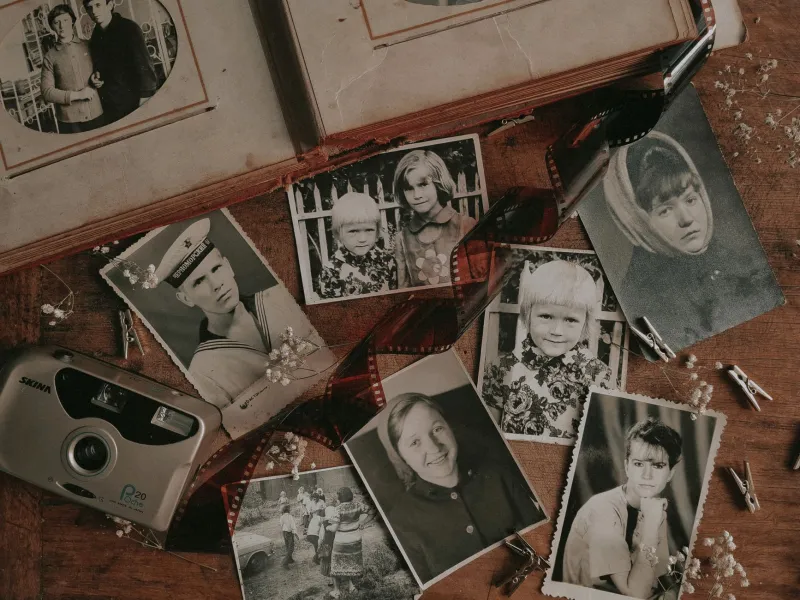
Somewhere in a closet, a garage, or the back of a spare bedroom, there's probably a box. Maybe it's a shoebox. Maybe it's a plastic bin with a cracked lid. Inside it are photographs — real ones, printed on paper, slightly waxy to the touch. Some of them have dates stamped on the back in orange ink. Some have handwriting in ballpoint pen: Christmas '89. Cape Cod. Jenny's graduation.
If you're lucky, there's also an album. Vinyl cover, sticky pages, the kind where the photos pressed under a sheet of clear film that's now yellowed at the edges. You haven't opened it in years. But you know exactly where it is.
Now think about where your photos from last summer are.
If you're like most Americans, they're somewhere on your phone. Maybe backed up to the cloud. Maybe not. There are probably hundreds of them, possibly thousands, and you haven't looked at most of them since the day you took them.
The Economics of Scarcity Made You Pay Attention
Understanding what changed requires understanding what photography actually cost before the digital era — not just in dollars, but in attention.
A roll of 35mm film gave you 24 or 36 exposures. That was it. Once you clicked through those frames, the roll was done, and you couldn't see any of the images until you had the film developed — a process that took anywhere from an hour at a one-hour photo lab to a week or two if you mailed it in or used a drugstore drop-off. Development and printing cost real money. A roll of film plus processing might run you $10 to $15 in the early 1990s — closer to $25 to $35 in today's dollars.
So you were careful. You didn't take forty-seven nearly identical photos of your kid blowing out birthday candles. You took two, maybe three, and you tried to make them count. Before you pressed the shutter, you actually looked at what you were photographing. You thought about the light. You told people to move closer together. You waited for the right moment instead of capturing every moment and sorting through the wreckage later.
That constraint wasn't a limitation. It was a form of curation happening in real time.
The Ritual That Built the Memory
The act of getting photos back from the developer was its own event. You'd pick up the envelope — yellow at some labs, white at others — and there was a specific anticipatory feeling to opening it. You'd flip through the prints right there at the drugstore counter, or in the car, or spread out on the kitchen table while everyone crowded around.
Some shots were blurry. Some were underexposed, faces lost in shadow. A few were inexplicably dark — the result of forgetting to advance the film or blocking the flash. Those imperfections were part of the experience. They were funny, or frustrating, or occasionally devastating if the one photo you really needed didn't come out.
But the ones that did come out — those went into an album. Someone sat down, usually a parent or a grandparent, and slid each photo into a sleeve or pressed it onto a sticky page, arranging them in some kind of order that told a story. Vacation photos together. Holiday photos together. The first day of school, the birthday party, the camping trip — each chapter of the year organized into a physical object that anyone could pick up and hold.
That act of organizing was also an act of remembering. You relived the event while you sorted the prints. You talked about it with whoever was in the room. The album became a shared artifact — something the family had made together, even if only one person did the actual work of assembling it.
The Paradox of the Infinite Archive
Here is the strange thing about the digital era: we have more photographs of our lives than any generation in human history, and most of us feel like we're losing our memories faster than ever.
The average American smartphone holds thousands of photos. Most of them are never printed. Most are rarely revisited. They exist in a vast, undifferentiated archive — organized loosely by date, searchable by the phone's AI, accessible in theory but experienced almost never. The photos from your daughter's third birthday are in there somewhere, sandwiched between seventeen screenshots of recipes you never made and forty-three nearly identical shots of a sunset.
When everything is saved, nothing is curated. And when nothing is curated, the past becomes a data set rather than a story.
There's research to support what many people intuitively feel. Studies on what psychologists call the "photo-taking impairment effect" suggest that photographing an experience can actually reduce how well you remember it — the act of outsourcing memory to the camera lets your brain disengage from the moment itself. When you knew you only had a few shots, you stayed present. When you know you can take unlimited photos, the experience becomes something to document rather than something to have.
The Album as a Family Technology
It's easy to be sentimental about photo albums in a way that glosses over the reality — plenty of families had boxes of unsorted prints that never made it into any album, and plenty of photos were lost, faded, or destroyed over the years. The past wasn't perfect.
But the photo album, at its best, was a genuinely powerful family technology. It was a physical argument that these moments mattered enough to preserve carefully. It was something you could hand to a child and say, this is where you came from, this is who we were. It was the thing people grabbed when the house was on fire.
Nobody grabs a cloud backup when the house is on fire. Not because they don't care about the photos — but because the photos don't feel like objects. They don't feel like they have weight.
The Box Under the Bed Knows Something We've Forgotten
That shoebox in the closet, the sticky-paged album in the garage — they represent something that the photo library on your phone doesn't, no matter how many terabytes it holds. They represent a decision. Someone decided these moments were worth the cost of film, the wait for development, the effort of organizing. Someone chose what to keep.
That choice is the memory. The rest is just storage.