Steel Towers and Skinned Knees: When American Playgrounds Actually Challenged Kids
The Death Trap That Built Character
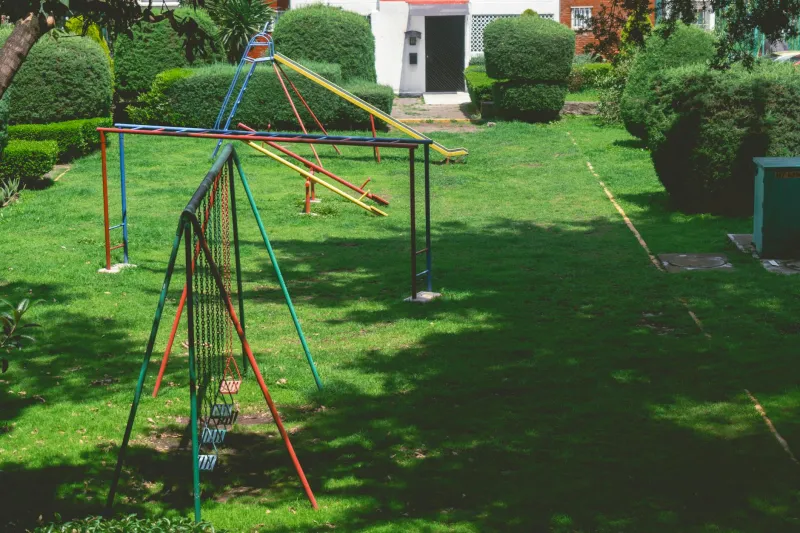
Picture this: a 15-foot-tall monkey bar structure made of unforgiving steel, planted directly over packed dirt and gravel. No safety barriers. No warning signs. No rubber padding underneath. Just cold metal, gravity, and the understanding that if you fell, you'd learn something about physics the hard way.
This wasn't a lawsuit waiting to happen—this was the standard American playground until the 1980s.
For generations of American kids, recess meant navigating genuine physical challenges that would send today's school administrators into panic attacks. Towering slides that actually required courage to climb. Spinning merry-go-rounds that could launch an unwary child into orbit. Seesaws that demanded cooperation and timing, or someone was getting launched skyward.
When Danger Was the Point
The playgrounds of the 1960s and 70s weren't designed by committee or filtered through risk assessment teams. They were built with a simple philosophy: kids need to test their limits, and sometimes that means getting hurt.
A typical elementary school playground featured equipment that would be condemned today. Metal slides that could reach surface temperatures hot enough to cause burns on sunny days. Jungle gyms that stretched 12 feet high with gaps wide enough for a child to fall through. Swings on chains so long that adventurous kids could wrap them around the top bar and create their own extreme sport.
The statistics tell the story. In 1975, the average playground injury rate was significantly higher than today, but something interesting happened alongside those scraped knees and broken arms: kids developed what researchers now call "risk assessment skills" naturally. They learned to gauge danger, test their own limits, and build genuine physical confidence.
The Great Safety Revolution
Everything changed in the 1980s when liability concerns and safety research collided with American playground design. The Consumer Product Safety Commission began issuing guidelines that would transform childhood play forever.
 Photo: Consumer Product Safety Commission, via consumerfed.org
Out went the towering structures. In came equipment designed to prevent falls from exceeding specific heights. The old packed dirt was replaced with engineered surfaces—first sand, then wood chips, and eventually the rubber mulch that dominates today's playgrounds.
By the 1990s, the transformation was complete. Slides were lower, shorter, and equipped with safety barriers. Merry-go-rounds largely disappeared. Swings were shortened and spaced farther apart. Everything was designed to minimize the possibility of injury, which it accomplished—but at a cost nobody fully calculated.
What We Gained and Lost
Today's playgrounds are undeniably safer. Serious injuries have plummeted, and parents can watch their children play without the constant fear that someone's going to end up in the emergency room.
But something else disappeared along with those dangerous jungle gyms: the opportunity for children to experience real physical challenge and develop genuine resilience.
Modern playground equipment is designed for what safety experts call "age-appropriate play," which often means equipment so safe it fails to engage older children. The result? Kids who would have spent recess conquering increasingly difficult physical challenges now stand around looking bored, or retreat to their phones.
The Comeback Kids
Interestingly, some communities are recognizing what was lost and fighting back. The "adventure playground" movement, imported from Europe, is gaining traction in American cities. These spaces intentionally include controlled risks—higher structures, natural materials, and yes, the possibility of minor injuries.
Research from these environments shows something remarkable: when children are allowed to engage with reasonable physical risks, injury rates often decrease. Kids develop better spatial awareness, stronger risk assessment skills, and more confidence in their physical abilities.
The Rubber Mulch Generation
For children growing up today, the idea of a 15-foot metal slide or a merry-go-round that could actually build up serious speed seems like something from another planet. They're the rubber mulch generation—safer, more supervised, and arguably less physically confident than their predecessors.
This shift reflects a broader change in how Americans think about childhood risk. We've moved from a culture that accepted minor injuries as part of growing up to one that sees any preventable harm as unacceptable negligence.
The Price of Perfect Safety
The sanitization of American playgrounds represents more than just equipment changes—it reflects a fundamental shift in how we prepare children for an uncertain world. The old playgrounds, for all their dangers, taught kids that they were capable of handling risk, making decisions, and recovering from mistakes.
Today's safer playgrounds protect children from physical harm but may leave them less prepared for the kinds of calculated risks that adult life requires. When every potential danger is eliminated from childhood, we may be raising a generation that struggles to assess and manage the real risks they'll face as adults.
The monkey bars are gone, replaced by equipment that looks challenging but is engineered to prevent real failure. The question isn't whether this change was necessary—it probably was. The question is whether we've found the right balance between safety and the kind of character-building challenge that only comes from occasionally falling down and getting back up.