Busy Signals, Party Lines, and the Lost Patience of the American Phone Call
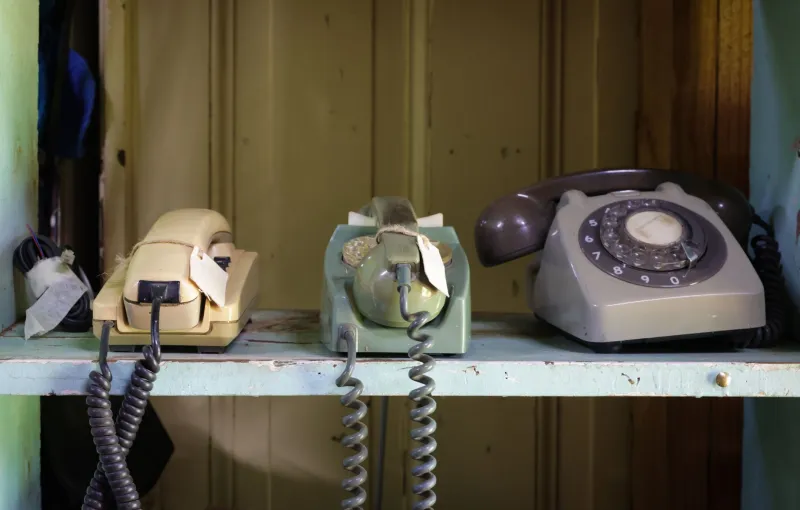
The Phone on the Wall Had Rules Nobody Wrote Down
In the American household of the 1950s, the telephone was not a personal device. It was shared property, and it came with an unspoken code of conduct that every family member understood without being explicitly taught.
You didn't call during dinner. You didn't call after nine o'clock at night unless something was wrong. You kept calls reasonably short because other people might need the line. You identified yourself when someone picked up. And if the person you were trying to reach wasn't home — well, you tried again later. There was no voicemail. There was no text. There was just the plan to call back, carried around in your head until you remembered to do it.
This was not considered inconvenient. It was simply how communication worked, and the social structures around it were elaborate, functional, and surprisingly effective.
What a Party Line Actually Was
For millions of Americans — particularly those in rural areas — the telephone situation was even more communal than a shared household phone. Party lines connected multiple households to a single telephone circuit, meaning that your neighbors could literally pick up their receiver and listen to your conversation if they felt like it.
This wasn't a flaw in the system. It was the system. Party lines were cheaper to operate and install than private lines, and telephone companies offered them as the entry-level option well into the 1950s and beyond. Each household on the line had a distinctive ring pattern — two short rings meant the call was for the Johnson family, one long ring meant it was for the Petersons — and the social contract required that everyone else ignore it.
Except, of course, that they didn't always. Party line eavesdropping was a minor American institution, somewhere between a guilty pleasure and a community news service. You'd pick up to make a call and discover your neighbor was already mid-conversation. You'd wait. Sometimes you'd hear something interesting. The etiquette required you to quietly hang up and try again later.
The party line created an accidental transparency in community communication that has no modern equivalent. People knew, in a vague and general way, that their phone calls were not entirely private. That knowledge shaped what they said and how they said it.
The Busy Signal Was Its Own Kind of Message
Before call waiting became a standard feature in the late 1970s and early '80s, reaching someone by phone was genuinely uncertain. You'd dial — actually dial, with a rotary mechanism that took real physical effort and couldn't be rushed — and then you'd listen.
A ring meant there was a chance. A busy signal meant there was not.
That sound — a sharp, repeating tone that translated directly to not now, try again — was one of the most common audio experiences in mid-century American life. It wasn't rude. It wasn't a rejection. It was simply information: this line is occupied, and you'll have to wait.
So you waited. You hung up, went about your business, and tried again in fifteen minutes. Or an hour. Sometimes you tried three or four times across an evening before you got through. Sometimes you gave up and caught the person at church on Sunday.
The patience required to navigate this system was not incidental. It was structural. The telephone infrastructure itself enforced a kind of communication rhythm that kept interactions from becoming constant. You couldn't reach people all the time, so you thought more carefully about when and why you were trying to reach them at all.
When Calling Was an Event
Long-distance calls occupied a different category entirely. Before telephone deregulation and the eventual collapse of per-minute long-distance charges, calling a relative in another state was a financial decision as much as a social one.
Families tracked long-distance calls the way they tracked utility bills. Calls were kept short and purposeful. You rehearsed what you needed to say before you dialed. Sunday evenings were the traditional time for family long-distance calls because the rates dropped after the business week — a scheduling convention so widely observed that it became a cultural ritual.
The $20 Sunday call — a real expense for a working-class household in 1970 — was not wasted on small talk. You covered the important things. You asked the questions that mattered. You said what you meant because the meter was running and everybody knew it.
That constraint produced a particular quality of conversation. The things said in those calls carried weight because they had been selected from everything that could have been said. The editing process happened before anyone picked up the phone.
What Friction Did for Human Relationships
Here's the counterintuitive thing about all that inconvenience: it worked. Not despite the friction, but partly because of it.
When reaching someone required effort — multiple attempts, waiting for the right time, navigating shared lines, keeping an eye on the clock — the act of finally connecting meant something. You'd earned the conversation. The other person knew you'd tried. The call itself carried the weight of all the attempts that preceded it.
Modern communication has essentially eliminated every one of those friction points. You can reach almost anyone, almost anywhere, at almost any time, through multiple simultaneous channels. A text, a DM, a voice message, an email, a tagged post — the options are endless and the cost is zero.
And yet, by nearly every measure, people report feeling less meaningfully connected than previous generations did. Loneliness statistics in the United States have been climbing steadily for decades, even as the raw volume of communication has exploded. The quantity of contact went up. The sense of genuine connection didn't follow.
The Etiquette That Held It Together
The unwritten rules of mid-century telephone culture weren't arbitrary. They reflected a shared understanding that communication was a resource to be used thoughtfully — that other people's time and attention had value, and that the act of reaching out carried a social obligation to make it worth their while.
You didn't call someone just to pass the time. You called because you had something to say. And when you got through, you said it.
Today's communication culture runs almost entirely on reflex. Messages are sent without much thought about whether they need to be sent at all. The expectation of immediate response has created a low-grade anxiety around unanswered texts that would have been completely foreign to someone raised on busy signals and party lines. An unread message feels like a small rejection. A delayed reply requires an explanation.
The old system asked more of everyone. It required patience on the sending end and genuine attention on the receiving end. In exchange, it produced conversations that both parties had actually prepared for — and that both knew might not happen at all, which made them matter more when they did.
What We Traded and What It Cost
Nobody is seriously arguing for a return to rotary phones and party lines. The ability to reach your kid instantly in an emergency, to coordinate across time zones without scheduling calls days in advance, to stay loosely connected with people you'd otherwise lose entirely — these are genuine improvements in human life.
But it's worth pausing to notice what got traded away. The friction that used to be built into phone communication wasn't just inconvenience. It was a natural pacing mechanism that kept conversations intentional, kept contact meaningful, and kept the social expectation of constant availability from becoming the exhausting norm it is today.
The busy signal didn't mean nobody cared. It meant not right now, but try again. And somehow, that turned out to be enough.