A Quarter, a Spinner Rack, and the Best Book You Never Knew You Needed
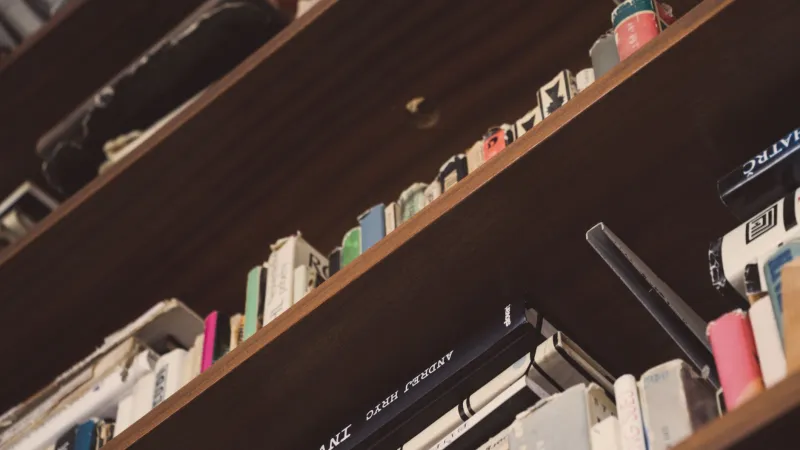
Somewhere between the aspirin and the greeting cards, there was a wire rack. It spun on a metal axis, its pockets stuffed with paperbacks whose spines were cracked, whose covers were lurid, and whose prices — twenty-five, thirty-five, maybe fifty cents — made them feel like almost no decision at all. You weren't necessarily there for a book. You were there for cough drops, or a bus ticket, or a pack of gum. But you spun that rack anyway, and sometimes — more often than you'd expect — something grabbed you.
That accidental moment of discovery built the reading lives of millions of ordinary Americans. And it's almost entirely gone.
The Original Algorithm Had Four Legs and a Spin
From the 1940s through the 1980s, the spinner rack was everywhere. Drugstores. Five-and-dimes. Bus depots. Grocery store checkouts. Airport newsstands. Laundromats. Anywhere Americans waited or wandered, someone had figured out that a few dozen paperbacks at impulse-buy prices would move. Publishers leaned into it hard. The mass-market paperback — small enough to fit in a coat pocket, cheap enough to leave on a train — was essentially engineered for this exact retail environment.
The covers were designed to do the selling. A woman in distress on a gothic cliff. A cowboy silhouetted against a burning sunset. A detective in a fedora squinting at something off-frame. You didn't need a review, a recommendation, or a bestseller list. You needed about fifteen seconds and a gut feeling. That was the whole system.
And it worked. Louis L'Amour sold hundreds of millions of paperbacks this way. So did Agatha Christie, John D. MacDonald, and countless authors who never made it into a "serious" literary conversation but built loyal audiences one spinner rack at a time. These weren't books people sought out. They were books people found.
What the Rack Actually Represented
Here's the part that gets lost in nostalgia: the spinner rack was genuinely democratic in a way that today's book culture struggles to be. You didn't need to live near a bookstore — and in rural America, that was a real barrier. You didn't need to know authors, follow publishing trends, or have a librarian guide you. You needed a quarter and a few minutes.
The selection wasn't curated by taste or algorithm. It was curated by whatever the distributor dropped off that week, which meant you might find a literary classic sitting next to a pulp western sitting next to a romance novel with a shirtless duke on the cover. Nobody was sorting you into a category. Nobody was tracking what you'd read before and steering you toward more of the same.
That randomness was the whole point. You might pick up a Ray Bradbury novel because the cover looked interesting and you'd never heard of him. That's how a lot of people met Ray Bradbury.
When Big Box Arrived, Something Small Left
The 1970s and 80s brought chain bookstores — B. Dalton, Waldenbooks, eventually Borders and Barnes & Noble. These were real improvements in many ways. More titles, more staff, more space to browse. But they were also destinations. You had to decide to go. You had to be in a mall or a shopping center. The accidental discovery that defined the spinner rack started to fade as book-buying became a more intentional act.
Then came Amazon, and then came everything else. Today, the algorithm decides what you see before you've even finished the book you're reading. Goodreads tracks your history. "Readers also enjoyed" banners follow you across the internet. The recommendation engine knows, with uncomfortable precision, that if you liked this, you'll probably like that.
It's efficient. It's often accurate. It has almost no element of surprise.
The Serendipity Tax
What we gave up is harder to quantify than what we gained. The modern reading experience is extraordinarily convenient. You can download a book in seconds, read reviews from thousands of strangers, and never run out of curated suggestions. But the books you find tend to look a lot like the books you've already read, because that's what the system is built to deliver.
The spinner rack had no such memory. It didn't know you. It just spun. And sometimes what came up when you stopped it with your finger was something completely outside your usual orbit — a genre you'd dismissed, an author you'd never encountered, a story set somewhere you'd never thought about. The rack didn't think you'd like it. It just happened to be there.
There's a specific kind of reading joy that comes from a book you didn't go looking for. The kind where you finish it on a bus or a porch or in a waiting room and sit there for a moment, a little stunned, thinking: where did that come from? The spinner rack produced that feeling with remarkable regularity.
What's Left of It
You can still find spinner racks in airport gift shops and the occasional pharmacy, though the selection tends to run toward celebrity memoirs and beach reads. Used bookstores carry some of that old randomness — you never quite know what you'll find — and some readers have deliberately sought them out as an antidote to algorithmic predictability. There's something almost countercultural now about walking into a secondhand shop and letting the shelves surprise you.
But the era when a wire rack in a drugstore was genuinely one of the primary ways Americans met new books? That's over. The infrastructure that made it work — the mass-market paperback distribution system, the five-and-dime culture, the idea that a book should cost about as much as a sandwich — has been replaced by something faster, smarter, and considerably less random.
What we traded away was the beautiful inefficiency of not knowing what you were looking for until you found it. The algorithm has made us better at getting what we want. It's just a lot worse at giving us what we didn't know we needed.