When the Lights Went Down, That Was the Only Place It Existed
The Only Record Was the One in Your Head
If you were at a concert in 1987 and the guitarist played a solo that made the whole room lose its mind, that moment belonged to the people in the room. There was no capturing it. No posting it. No way to show anyone who wasn't there what it felt like, except to tell them — and telling them was never quite enough, which was exactly the point.
You had to be there. That phrase used to mean something specific and irreversible. It meant that an experience existed in a single location, at a single time, and if you weren't present, it was gone. Not archived. Not available on demand. Gone.
That scarcity — real, structural, non-negotiable — shaped everything about how Americans experienced live events for most of the twentieth century. It shaped why people went, what they paid, how they behaved when they got there, and what they carried home.
The Economics of Being Present
When an experience is genuinely irreplaceable, presence has a different value.
The decision to attend a concert or a ball game or a Broadway touring production wasn't just a leisure choice — it was a commitment. You bought the ticket weeks in advance. You made arrangements. You drove, sometimes for hours. You stood in line. And when you finally got inside, the investment you'd made in getting there changed how you experienced being there.
You were paying attention in a way that's difficult to describe to someone who grew up with a phone in their pocket. Not because you were better or more disciplined, but because attention was the only tool you had. There was no second screen to check. There was no way to verify what you were seeing against someone else's clip of the same moment. There was just the stage, the crowd, the sound, and you.
People remembered concerts the way they remembered important events in their lives — with specific sensory detail that stayed sharp for decades. The smell of the venue. The exact moment the lights dropped. The stranger next to them who sang every word. These memories were vivid because they were the only record that existed.
What Changed, and When
The shift didn't happen all at once. It crept in gradually, the way most cultural changes do.
Disposable cameras showed up at events in the late 1980s and 1990s, and venues started asking people not to use them — not out of nostalgia for pure experience, but because artists and promoters wanted to control how their performances were documented. The instinct to capture was already there. The technology just kept getting more accessible.
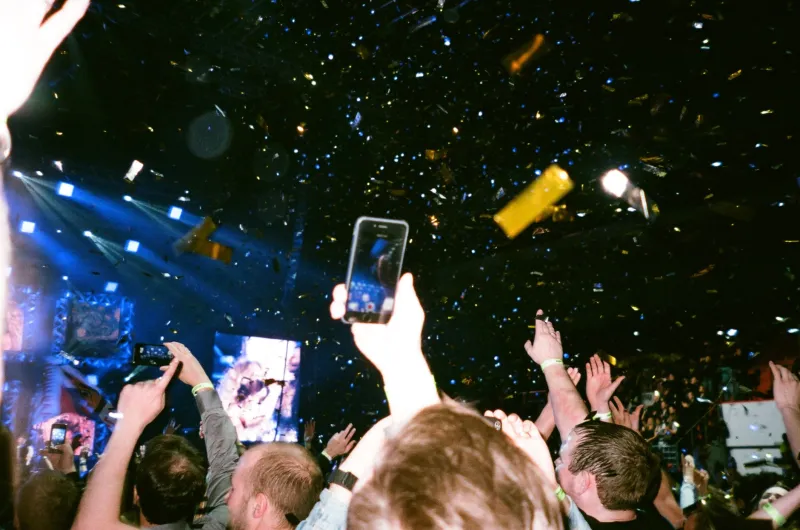
By the mid-2000s, digital cameras were everywhere. By 2010, every smartphone in every pocket was a video studio. And somewhere around 2012 or 2013 — you can pick the exact moment differently depending on who you ask — the sea of raised screens at concerts became the new normal rather than the exception.
Livestreams followed. Then pay-per-view event broadcasts. Then full concert films on streaming platforms. Then artists posting their own multi-camera recordings within days of a show. The infrastructure of irreplaceability dismantled itself, piece by piece, in the name of reach and revenue and the democratization of access.
All of which are legitimate things. None of which are free.
The New Reason to Go
Here's the honest question the shift forces us to ask: if you can watch a recording of the show from your couch, in high definition, with better sound than you'd get in the nosebleeds, why are you going?
For a lot of people, the answer has quietly changed. You're not going to experience something irreplaceable. You're going to be part of something documented. The event is now partly a content opportunity — for the artist, for the venue, and for the attendee, whose Instagram story from the floor section is its own kind of social currency.
This isn't cynical, necessarily. People have always wanted to share experiences they love. The impulse is genuine. But the act of documenting changes the experience in ways that are hard to fully account for.
When you hold up your phone to record a moment, you are, by definition, experiencing that moment through a screen. The raw, present-tense impact of the thing happening in front of you gets filtered through the task of capturing it. You're thinking about framing, about whether the sound will be good, about what you'll caption it. You're partly somewhere else.
The Scarcity That Made It Sacred
There's a specific kind of meaning that attaches to experiences you can't get back. Historians and psychologists have different names for it, but most people recognize it intuitively: the thing you can only have once tends to matter more than the thing you can revisit whenever you want.
Old concert-goers will tell you about shows they attended decades ago with a specificity and emotion that's striking. They remember what the room felt like. They remember which song broke them open. They remember turning to a stranger and both of them shaking their heads because there were no words.
They remember it that way because remembering was the only option. The experience lived in them because it had nowhere else to go.
Still Worth Going
None of this means live events have lost their value. They haven't. The energy of a crowd, the physical reality of sound at volume, the specific electricity of watching something happen in real time — those things survive the smartphone era. They're still real.
But the nature of the experience has shifted in a way worth being honest about. We go to events now with the option to document, to share, to replay. That option changes the relationship between the attendee and the moment, even when the attendee chooses not to use it.
The unrepeatable event still exists. It's just harder to let it be unrepeatable when everything around you is designed to make sure it doesn't have to be.
Sometimes the most radical thing you can do at a concert is put the phone away and let the moment disappear.