The Free Pool Where the Whole Town Got Wet: America's Lost Summer Institution
The Free Pool Where the Whole Town Got Wet: America's Lost Summer Institution
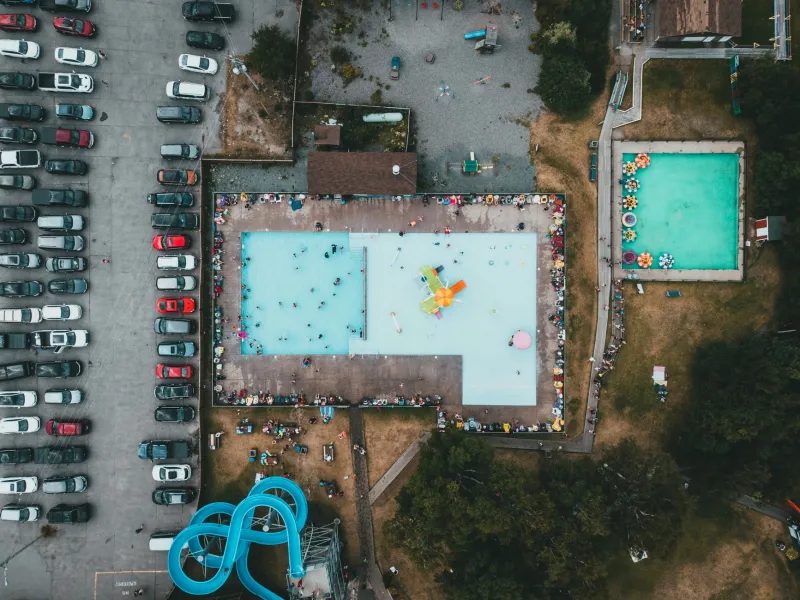
You could hear it before you saw it. The shrieking, the splashing, the lifeguard's whistle cutting through a humid July afternoon. The smell hit you next — chlorine so thick it practically had a physical presence. And then you'd come around the corner or through the chain-link gate and there it was: the town pool, packed shoulder to shoulder with half the kids in the county, and it cost you nothing to get in.
For a generation of Americans who grew up in the postwar decades, the municipal pool wasn't a luxury. It was a given. It was where summer happened.
That institution is now largely gone, and most people under thirty have never experienced what it actually felt like to live in a town that provided one.
How the Public Pool Was Born
America's municipal pool boom was a product of a specific historical moment. The postwar economic expansion of the late 1940s and 1950s created both the political will and the financial capacity for cities and towns to invest in public amenities at a scale that seems almost unimaginable today. Public pools were part of a broader civic vision — alongside public libraries, public parks, and public recreation centers — that held that communities had an obligation to provide shared spaces for everyone, regardless of income.
Federal funding helped. The New Deal had already seeded the idea in the 1930s, with the Works Progress Administration building hundreds of pools across the country as part of its public works agenda. The postwar years accelerated the build-out. By the mid-1960s, nearly every mid-sized American city had at least one municipal pool, and many smaller towns had one too. Entry fees, where they existed at all, were nominal — a quarter, sometimes a dime, sometimes nothing.
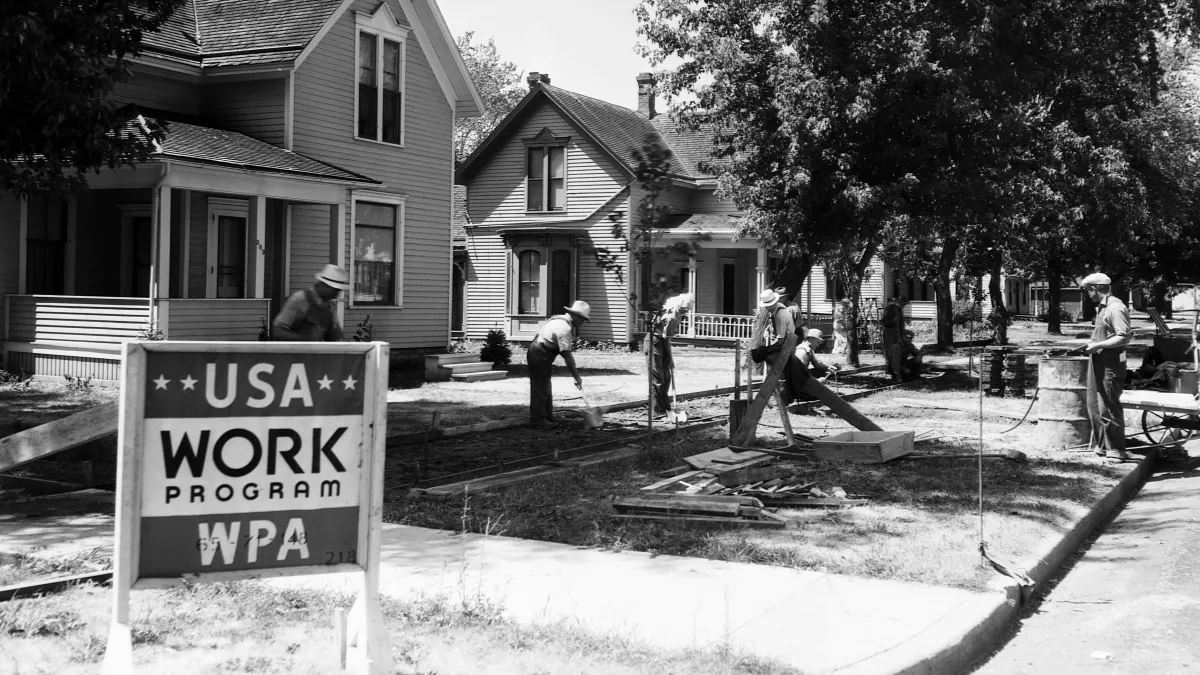 Photo: Works Progress Administration, via assets.editorial.aetnd.com
The pools were big. Not the modest rectangles you see in backyards today, but genuine community-scale facilities. Fifty meters long. Diving boards at one end. A shallow section where little kids could splash without getting in anyone's way. Concession stands selling popsicles and candy bars. Bathhouses with actual changing rooms.
And they were genuinely democratic spaces. The kid whose family owned the nicest house in town and the kid whose family was scraping by that summer were standing in the same water, waiting in the same line for the high dive.
The Lifeguard Who Knew Your Name
There's a social texture to the old public pool that's easy to underestimate if you never experienced it. Because the same pool served the same community year after year, the staff developed real familiarity with the families who showed up every summer. Lifeguards were often local college students or older teenagers who'd grown up swimming in that same pool. They knew which kids needed watching. They knew which parents would be picking up which children at five o'clock.
It was, in the best sense, an extension of the neighborhood. The relationships formed at the public pool weren't transactional. You didn't need a membership card or a wristband. You just showed up, and the community absorbed you.
For kids without older siblings or parents who could drive them to private clubs, the municipal pool was often their entire summer social life. It was where friendships formed, where crushes developed, where you spent six straight hours in the water and went home sunburned and happy and completely exhausted in the best possible way.
The Long Decline
The story of how America lost its public pools is complicated, and no single cause tells the whole story. But a few threads are hard to ignore.
The first is money. As federal and state funding for municipal services contracted through the 1970s and 1980s, cities were forced to make hard choices about what to maintain and what to cut. Public pools are expensive to operate. They require lifeguards, chemicals, filtration systems, and regular structural maintenance. When budgets tightened, pools were often among the first casualties — particularly in lower-income cities and towns where the need was greatest and the tax base was smallest.
The second thread is demographic change and the politics that followed. As American suburbs grew and white middle-class families increasingly moved to communities with private swim clubs or HOA amenities, the political constituency for maintaining public pools weakened. The people who might have advocated loudest for keeping the municipal pool open were the same people who'd relocated to neighborhoods where they no longer needed it.
The history of racial segregation also shaped this story in ways that can't be ignored. Many public pools in the South and parts of the North were segregated by law or by practice well into the 1960s. When desegregation orders came, some municipalities chose to close their public pools rather than integrate them — a decision that drained the civic investment from communities that had relied on those facilities the most. The downstream effects of those choices lasted for generations.
By the 1990s and 2000s, the closures were accelerating. The CDC estimates that the US has lost thousands of public pools over the past several decades. Many of the facilities that remain are aging, underfunded, and open for only a fraction of the summer.
What Took Its Place
For families with money, the private swim club filled the gap. Many suburban communities have membership-based pools that offer essentially the same experience as the old municipal pool — minus the open admission and the economic diversity. Annual memberships at private clubs in metro areas commonly run $800 to $2,500 per family, putting them well out of reach for a significant portion of the population.
Backyard pools have also expanded dramatically. Roughly 5.7 million residential pools were installed in the US between 2019 and 2023 alone, driven partly by pandemic-era spending. A backyard pool is a private amenity, enjoyed by one household. It creates no community. It connects no neighbors. It's the opposite of what the municipal pool represented.
The HOA pool — a common feature of newer suburban developments — occupies a middle ground, available to residents of a particular development but closed to everyone else. It's community in the narrowest possible sense: shared within a defined boundary, but walled off from the broader public.
A Reflection Worth Making
The public pool was never just about swimming. It was a physical expression of a particular idea about what towns owe their residents — that some things should be available to everyone, that shared space creates shared identity, that a community is stronger when it actually mixes.
The decline of the public pool didn't happen in isolation. It happened alongside the decline of other freely shared public spaces — the public library reduced to a skeleton staff, the public park left unmaintained, the public recreation center converted to condos. Each individual loss seemed manageable. Collectively, they added up to something much larger.
The sound of a full public pool on a July afternoon — that specific, irreplaceable noise of a community cooling off together — is harder to find than it used to be. And the silence where it used to be says something about how America changed.