Your Neighborhood Oracle Sold Screws: When Hardware Stores Were Universities of Getting Things Done
The Professor Behind the Counter
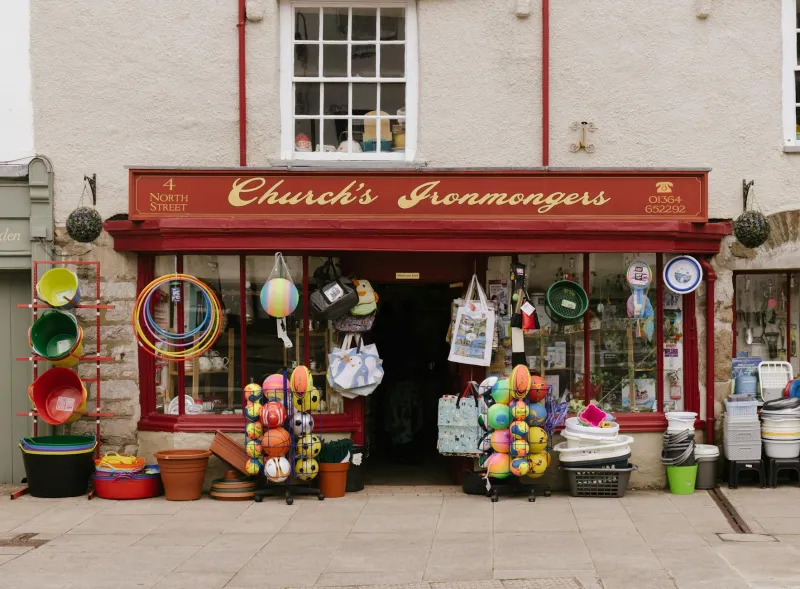
Walk into Kowalski's Hardware on Main Street in 1972, and you'd find Joe Kowalski himself behind a wooden counter worn smooth by decades of elbows. Spread before him like a general's war room were drawers containing every conceivable fastener, widget, and doodad known to American homeownership.
 Photo: Kowalski's Hardware, via woodburymag.com
Joe didn't just sell hardware — he was a walking encyclopedia of how things worked and why they broke. Bring him a bent bracket from your screen door, and he'd not only find you the replacement, but explain why the original failed and how to install the new one so it wouldn't happen again.
This wasn't customer service. It was community education, delivered one broken faucet at a time.
The University of Practical Knowledge
The neighborhood hardware store functioned as America's informal technical college. Need to know the difference between a carriage bolt and a hex bolt? Joe would show you both, explain when to use each, and probably tell you about the time he fixed Mrs. Peterson's porch swing with the wrong bolt and had to redo it.
Knowledge flowed in all directions. Customers shared tips about which paint held up best on aluminum siding, which brand of caulk actually stayed flexible through Minnesota winters, and whether that new electric drill was worth the extra money.
The hardware store was where you learned that WD-40 wasn't actually a lubricant, that you should always drill a pilot hole, and that the cheapest tool was rarely the best value. These lessons came free with every purchase, delivered by people who'd learned them the hard way.
The Archaeology of Inventory
Step into the back room of a 1970s hardware store, and you'd discover archaeological layers of American manufacturing. Coffee cans filled with screws sorted by thread pitch. Wooden drawers labeled with masking tape containing washers from companies that went out of business in 1954. Bins of electrical fittings that still worked perfectly despite being manufactured when Eisenhower was president.
Joe knew where everything was, even if the organizational system looked like chaos to outsiders. He could reach into a drawer without looking and pull out exactly the right toggle bolt for your drywall project. The store was an extension of his memory, and his memory contained solutions to problems you didn't know you had.
Modern big-box stores organize inventory by computer algorithms and product categories. Everything has a SKU number, a planogram position, and a bar code. It's efficient, logical, and completely useless when you need a replacement part for something made in 1963.
The Death of the Know-It-All
By 1980, there were over 25,000 independent hardware stores in America. Today, fewer than 12,000 remain. They didn't just close — they were obliterated by big-box retailers who could sell the same screwdriver for half the price.
The economics were brutal and simple. Why pay Joe $2.99 for a hammer when Home Depot sold the same hammer for $1.99? The answer — Joe's expertise, personal service, and ability to solve problems — wasn't visible on the price tag.
 Photo: Home Depot, via d3cnqzq0ivprch.cloudfront.net
Customers voted with their wallets, choosing lower prices over local knowledge. Only later did they discover what they'd lost: the guy who could look at your broken whatever and immediately know how to fix it.
Navigating the Orange Maze
Today's hardware shopping experience would bewilder a time traveler from 1970. You park in a lot the size of a small town, grab a cart built for hauling lumber, and enter a warehouse containing 40,000 different products spread across 100,000 square feet.
Need a quarter-inch bolt? That'll be in aisle 12, bay 3, facing 7, approximately 200 feet from the entrance. Hope you brought comfortable shoes and a smartphone with GPS.
The scale is impressive but intimidating. Everything is there, somewhere, organized by corporate planners who've never actually fixed a leaky faucet. Finding what you need requires either extensive product knowledge or a willingness to wander aisles reading package labels.
The Teenager in the Orange Vest
When you finally locate a store employee, you'll likely encounter someone who started working there last month and whose training consisted of learning to operate the register and direct customers to the correct aisle.
Ask them whether a 5/16-inch lag bolt will hold a porch swing, and you'll get a blank stare followed by "Let me call someone." The someone they call might know the answer, or they might just read the product packaging out loud.
This isn't the employees' fault — they're not hired for expertise, they're hired to stock shelves and process transactions. The knowledge that Joe provided over decades of experience isn't something you can teach in a two-hour orientation video.
The DIY Paradox
Ironically, the death of knowledgeable hardware stores coincided with the rise of DIY culture. Home improvement shows made everyone believe they could renovate their kitchen over a weekend. YouTube tutorials promised to teach you anything you needed to know.
But YouTube can't look at your specific problem and suggest a creative solution. It can't warn you that the technique in the video won't work with the wiring in your 1950s house. It can't recommend a better approach based on 30 years of seeing what actually works.
The result is a generation of ambitious DIYers armed with power tools and confidence but lacking the practical wisdom that used to come free with every hardware store visit.
The Price of Efficiency
Big-box stores revolutionized hardware retail through economies of scale, sophisticated logistics, and ruthless efficiency. They can stock more products, offer lower prices, and serve more customers than any neighborhood store ever could.
What they can't replicate is the relationship between Joe and his customers. They can't provide the kind of personalized problem-solving that comes from knowing your house, your skill level, and your budget. They can't offer the community gathering space where local contractors shared trade secrets with weekend warriors.
The efficiency came at a cost: the loss of local expertise, personal relationships, and the kind of practical education that turned homeowners into capable problem-solvers.
The Survivors
The independent hardware stores that survived did so by specializing in what big-box stores couldn't provide: knowledge, service, and community connection. They became the places you go when you need more than just a product — when you need a solution.
These survivors often focus on specific niches: antique restoration hardware, marine supplies, or specialty tools. They compete not on price but on expertise, serving customers who value knowledge over convenience.
Some have even thrived by embracing their role as educators, offering classes on home repair, tool use, and traditional crafts. They've become community colleges of practical knowledge, teaching skills that YouTube videos can't convey.
What We Built Instead
Today's hardware shopping experience prioritizes selection and price over personal service. You can buy a toilet at 2 AM, order specialty fasteners online for next-day delivery, and compare prices across multiple retailers without leaving your couch.
We've gained convenience, selection, and savings. We've lost the neighborhood professor who could teach you not just what to buy, but how to use it, when to use it, and why it would work better than the obvious solution.
The question isn't whether this trade-off was worth it — it's whether we realize what we gave up when we chose the warehouse over the wise man behind the counter.